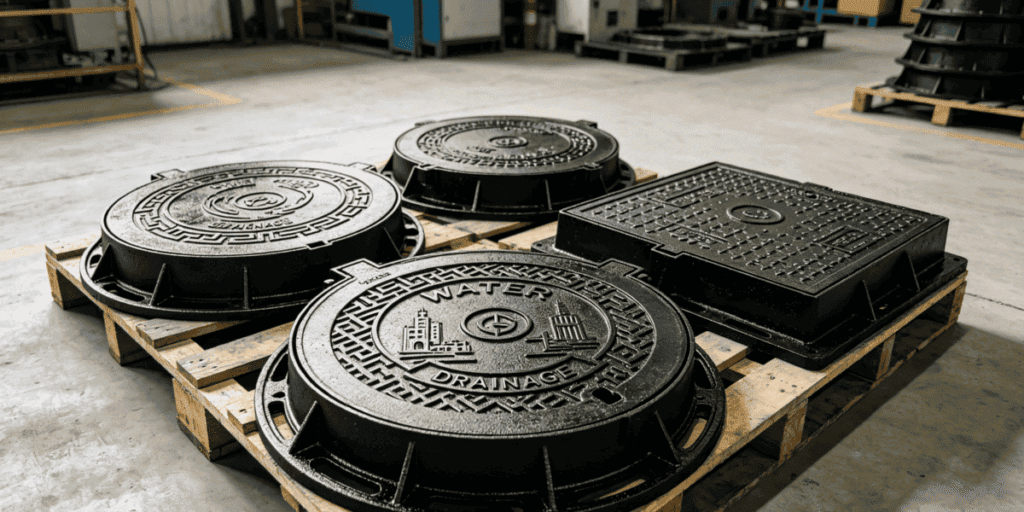
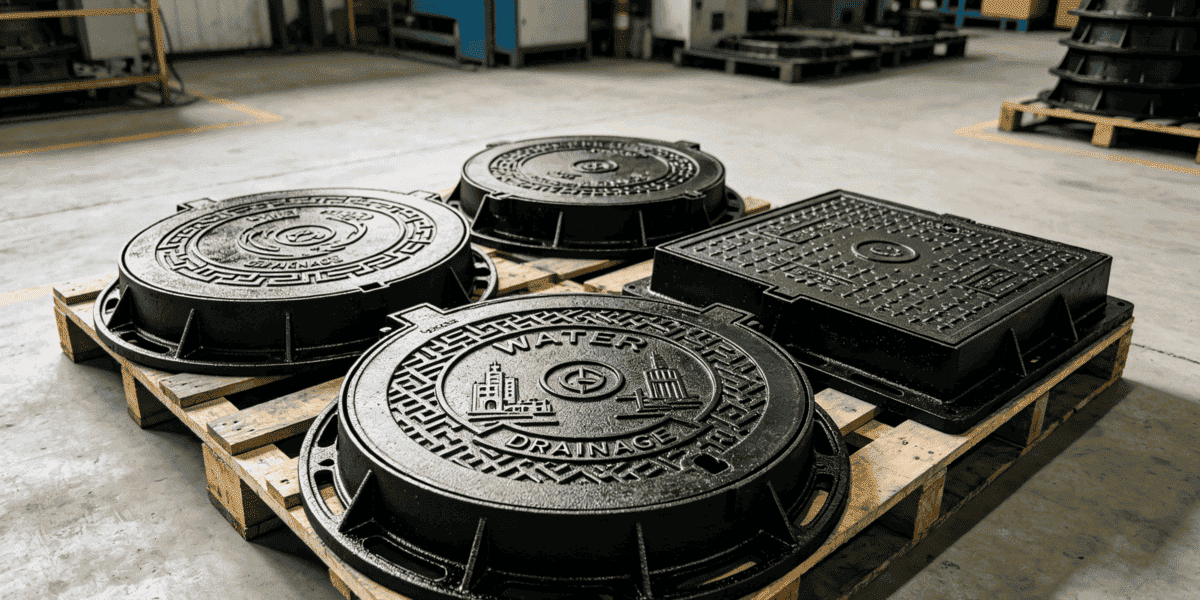
Manhole covers are a permanent part of the urban environment. On city streets, public squares, parks, commercial districts and municipal infrastructure projects, they are visible to pedestrians and drivers every day. For this reason, many municipal projects, landscape developments and city renovation programs now specify custom logo manhole covers – covers that carry a city emblem, project identity, utility marking or decorative surface pattern as part of the overall design brief.
But custom design has to work alongside engineering requirements, not instead of them. A manhole cover installed on a public road still needs to meet the correct load class. A decorative cover in a pedestrian plaza still needs to provide adequate anti-slip performance. A cover carrying a municipal logo still needs to fit the frame properly and remain stable under repeated loading.
This guide covers what municipal projects and infrastructure buyers should consider when specifying custom logo manhole covers, from material selection and load class to artwork requirements, mold development and export delivery.
Why Municipal Projects Use Custom Logo Manhole Covers
The decision to specify custom logo manhole covers on a project is usually driven by one or more of the following requirements.
City Branding and Public Identity
In public squares, parks, commercial streets, central business districts and city renovation projects, infrastructure details contribute to the overall visual environment. Municipal authorities and landscape architects increasingly treat manhole covers as part of the streetscape rather than purely functional components. A cover carrying the city emblem or a project-specific pattern helps maintain visual consistency across public spaces and reflects attention to detail in the built environment. This is particularly common in municipal landscape projects, heritage zones and high-footfall pedestrian areas.
Utility Identification and Maintenance
Text markings on manhole covers serve a practical function beyond branding. Labels such as WATER, SEWER, TELECOM, DRAINAGE and ELECTRIC allow maintenance teams to identify underground services quickly without referencing separate documentation. In large infrastructure projects with multiple service types running beneath the same streetscape, clearly marked covers reduce the risk of incorrect access and support faster response during maintenance or emergency works.
Asset Protection and Anti-Theft Management
Manhole covers carrying a municipal authority name, project code or distinctive logo pattern are more difficult to remove and resell anonymously. Custom markings act as a visible deterrent and make it easier to identify misappropriated covers. For large municipal projects where cover replacement represents a significant cost, logo marking is a straightforward way to reduce asset loss over the lifespan of the installation.
What Can Be Customized on a Manhole Cover?
Custom manhole covers are not limited to logo marking. Depending on the project requirement, multiple elements can be adjusted during the casting and finishing process.
Logo, Text and Utility Marking
A city logo, project name, municipal department marking, utility label or combination of text and graphic elements can be incorporated into the cover surface. The quality of the result depends on the artwork provided. For best results, buyers should supply artwork in AI, PDF, DWG or DXF format, or as a high-resolution file with clear line weights. Fine details and small text require sufficient depth in the casting pattern to remain legible after surface treatment and long-term use.
Surface Pattern and Anti-Slip Texture
The surface of a manhole cover can carry a decorative pattern, a city-themed design or a specific anti-slip texture. For covers installed in pedestrian areas, the surface pattern must provide adequate slip resistance regardless of its decorative function. Buyers should confirm that the chosen pattern meets the relevant safety requirements for the installation environment. Decorative surface design and pedestrian-safe texture are not mutually exclusive, but the engineering requirement takes priority.
Shape, Size and Clear Opening
Standard cover shapes include round, square and rectangular. Clear opening size, overall frame size and total depth can be specified to match project drawings or existing frame installations. For replacement projects, buyers should confirm all dimensions against the installed frame before placing an order, as minor variations between manufacturers can affect fit.
Frame Type and Installation Detail
Buyers can specify cover only, or cover with matching frame. Frame options include standard seating, hinged design, locking mechanism and non-rock seating for high-traffic road applications. The choice of frame type affects installation method, maintenance access and long-term performance under repeated loading.
Coating, Color and Surface Finish
Standard surface treatment is black bitumen coating. Epoxy coating, painting and other custom finishes are available depending on the project requirement. Buyers specifying a particular color or finish for aesthetic reasons should confirm that the coating is compatible with the installation environment and expected maintenance cycle.
For projects that require special patterns, artwork or non-standard structures, buyers can also review our custom casting solutions and decorative cast iron covers.
Material and Load Class for Custom Ductile Iron Manhole Covers
Custom logo design should not change the required material, load class or installation performance. This is the point that matters most when specifying custom manhole covers for municipal and infrastructure projects.
Ductile iron is the preferred material for most municipal applications. Compared with grey cast iron, ductile iron manhole covers offer significantly higher toughness and impact resistance, making them better suited to the dynamic loading conditions found on public roads, commercial streets and infrastructure projects with heavy or unpredictable traffic. Their mechanical properties also allow for thinner, lighter casting profiles without compromising structural performance, an advantage where cover weight affects handling and installation logistics.
For this reason, a custom ductile iron manhole cover should be reviewed as both a branded streetscape element and a load-bearing infrastructure component.
Load class selection must be based on the installation environment, not on aesthetic preference. The EN124 standard defines load classes from A15 through to F900. For most municipal projects, B125, C250 and D400 are the most commonly specified classes. Logo marking, cast-in surface patterns and decorative finishes do not affect the structural classification of the cover, provided the underlying casting geometry and material meet the required specification.
Choosing a lower load class only to reduce unit cost can lead to higher replacement and maintenance costs if the installation area actually requires a stronger cover. For more background on load class selection, you can also read our EN124 manhole cover load classes guide.
| Application Area | Recommended Material | Typical Load Class | Customization Focus |
|---|---|---|---|
| Parks and pedestrian areas | Ductile iron | B125 | Decorative pattern, city logo, recessed design |
| Kerbside and side streets | Ductile iron | C250 | Anti-slip surface, utility marking, frame fit |
| Public roads and carriageways | Ductile iron | D400 | Heavy-duty structure, non-rock design, clear marking |
| Industrial or port areas | Ductile iron | E600 / F900 where required | Heavy-duty frame, project marking, reinforced design |
From Artwork to Casting: How the Custom Process Works

Understanding the production process helps buyers set realistic expectations for lead time, minimum order quantities and artwork requirements.
Drawing and artwork review. The buyer provides logo files, technical drawings and cover specifications. The supplier reviews the artwork for casting feasibility, checking line weights, text size, pattern depth and overall layout against the casting process limitations.
Mold or pattern development. For new logo designs or non-standard surface patterns, a casting pattern or mold needs to be developed. This is a one-time cost that is typically recovered across the production run. The complexity of the logo and the required surface detail affect both the development cost and the time needed before sampling can begin.
Sample confirmation. Before mass production begins, a physical sample is produced for the buyer to review. This is the stage where logo clarity, surface finish, dimensions and frame fit should be confirmed. Changes requested after mass production begins will affect both cost and schedule.
Mass production. Once the sample is approved, production proceeds according to the confirmed specification, load class and quantity.
Surface treatment and export packaging. After casting and dimensional inspection, covers go through the specified surface treatment before being packed for ocean freight. Export packaging is confirmed based on the destination port, quantity and buyer requirements.
For a customized ductile iron manhole cover, the design review should include both the visible surface pattern and the structural details hidden below the cover face. Logo clarity in the finished product depends on the quality of the original artwork, the depth of the casting pattern, the surface texture and the mold development process.
What Buyers Should Confirm Before Ordering
For custom manhole cover orders, the more complete the information provided upfront, the smoother the production and delivery process. Before placing an order or requesting a quotation, buyers should be prepared to confirm the following:
- Logo file or artwork, with AI, PDF, DWG or DXF preferred
- Clear opening size
- Overall frame size
- Cover shape, such as round, square or rectangular
- Required load class, such as B125, C250, D400 or other project requirement
- Installation area and traffic type
- Material requirement, such as ductile iron or other specified material
- Surface pattern or anti-slip texture requirement
- Coating or finish requirement
- Order quantity
- Destination port
- Packaging requirement
- Available drawings or physical samples for reference
Providing complete information at the inquiry stage reduces the risk of specification errors and avoids delays during the drawing review and sample confirmation stages.
Common Applications for Custom Logo Manhole Covers
Custom logo manhole covers are used across a wide range of municipal and infrastructure project types. The table below summarizes common applications and the typical customization focus for each.
| Application | Typical Cover Type | Common Custom Detail |
|---|---|---|
| City streets | Ductile iron manhole cover | City logo, utility marking, anti-slip pattern |
| Parks and plazas | Decorative manhole cover | Landscape pattern, recessed surface, project identity |
| Commercial streets | Custom ductile iron cover | Logo marking, pedestrian-safe surface |
| Residential areas | Municipal manhole cover | Simple text marking, standard frame |
| Airports, ports and industrial zones | Heavy-duty custom cover | Reinforced frame, load class marking, project code |
Quality Control for Custom Cast Iron Covers
Custom orders go through the same inspection process as standard production. Before shipment, each cover is checked for logo clarity, casting appearance, surface pattern consistency, dimensional accuracy, cover and frame fit, load class marking, coating condition, batch consistency and packaging condition.
For custom orders, dimensional inspection is particularly important. A cover that meets the correct load class but does not seat properly in the frame will cause problems on site. Frame fit should be confirmed during the sample stage, before mass production begins.
For buyers who require third-party inspection before shipment, arrangements can be made with SGS, BV or TUV inspectors at our facility. Quality documents such as material certificates, dimension reports and pre-shipment photos can be provided according to order requirements. You can find more detail on our quality control process page.
Frequently Asked Questions
What information is needed for custom logo manhole covers?
To begin the review process, we need the logo file or artwork, clear opening size, overall frame size, cover shape, required load class, installation area, material requirement, surface pattern preference, coating requirement, quantity and destination port. A drawing or physical sample for reference is also helpful where available.
Can we add our city logo or project name to the cover?
Yes. City logos, project names, municipal department markings and utility labels can all be incorporated into the cover surface. The result depends on the quality of the artwork provided and the feasibility of the design within the casting process. Fine lines, small text and complex graphics may need to be adjusted to achieve a clean result in the finished casting. We review artwork before production begins and advise on any changes needed.
Do custom logo manhole covers still meet EN124 load classes?
Yes, provided the underlying casting structure is designed to the required load class. Logo marking and cast-in surface patterns are applied to the cover face and do not affect the structural classification of the product. The load class is determined by the casting geometry, material grade and frame design, not by the surface decoration. Buyers should confirm the required load class based on the installation environment before ordering.
What is the typical MOQ for custom manhole covers?
Custom orders involving new logo patterns or non-standard surface designs require mold or pattern development before production can begin. The minimum order quantity depends on the cover size, pattern complexity and project requirements. We review each inquiry individually and advise on the most practical production arrangement based on the quantity and specification involved.
Can decorative manhole covers be used in traffic areas?
Yes, but the material, casting structure and load class must be appropriate for the installation location. A decorative cover installed on a public road or carriageway must still meet D400 or the load class specified in the project documents. Surface decoration does not change the structural requirement. If the project involves both pedestrian and vehicle access areas, different load classes may be needed for different zones.
Ready to Discuss Your Custom Project?
If you are planning a municipal, road, landscape or utility project that requires custom logo manhole covers, send us your drawing, logo file, size, load class, quantity and destination port. Our team can review the details and suggest a suitable custom casting option based on your project requirements.
We work with contractors, distributors and municipal project buyers in overseas infrastructure and drainage projects. Whether you need a small run of logo covers for a city plaza or a larger project order for road infrastructure, we can work through the specification with you before production starts.