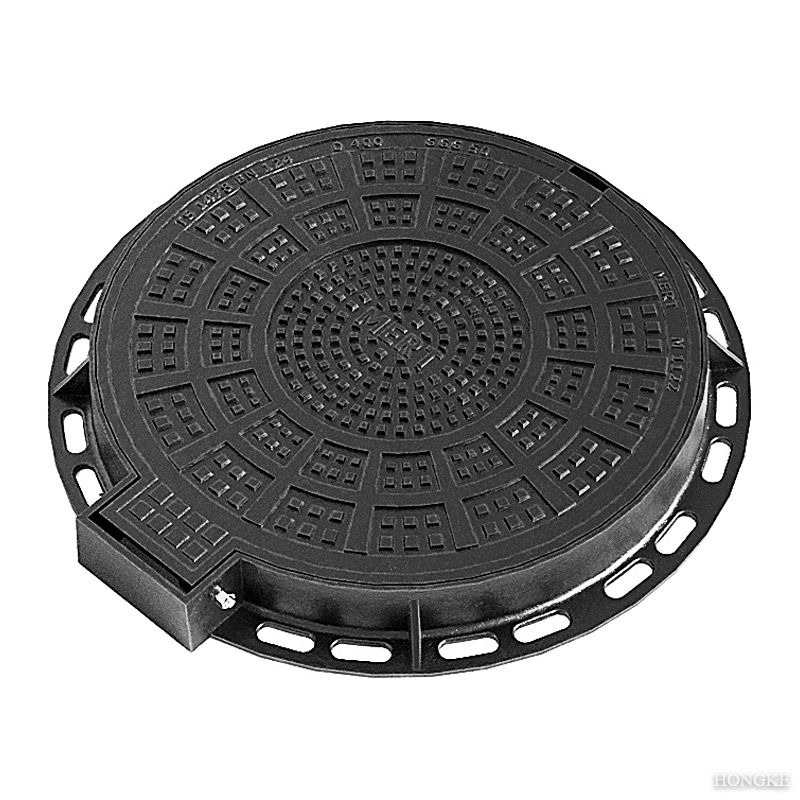
Ductile iron manhole covers are widely used in municipal roads, drainage systems, utility networks, and infrastructure projects where strength, safety, and long service life are important. When buyers compare ductile iron with traditional grey cast iron, the difference is not only about price. The material structure, load capacity, impact resistance, and total cost over time can all affect the final purchasing decision.
When buyers compare manhole covers for municipal roads, drainage projects, utility networks, or infrastructure upgrades, price is often the first thing they look at. That is understandable. A manhole cover may seem like a simple casting product, and at first glance, many covers look quite similar.
But in real projects, the material behind the cover makes a big difference.
At Hongke, we often speak with contractors, distributors, and project buyers who ask the same question:
What is the real difference between ductile iron manhole covers and traditional grey cast iron manhole covers? And which one should we choose?
The short answer is: for most road, drainage, municipal, and heavy-duty applications, ductile iron is the safer and more cost-effective option in the long run. Grey cast iron may still have a place in light-duty or pedestrian areas, but it is not suitable for every project.
Let’s look at the difference from a practical engineering and purchasing point of view.
The Real Difference Starts Inside the Material
Both ductile iron and grey cast iron belong to the cast iron family. However, their internal structures are very different.
In grey cast iron, the graphite exists in thin flakes. These flakes create weak points inside the metal. When the cover is exposed to impact, vibration, or repeated traffic loads, stress can concentrate around those flakes. This is why grey cast iron is more brittle and more likely to crack suddenly.
Ductile iron is different. During production, spheroidizing elements such as magnesium are added to change the graphite from flakes into rounded nodules. This small change in structure makes a big difference in performance.
Because of this nodular graphite structure, ductile iron offers much better strength, toughness, and impact resistance while still keeping the good castability and corrosion resistance of cast iron.
For high-quality ductile iron manhole covers, QT500-7 is commonly used. It is equivalent to EN-GJS-500-7 under international standards. A good nodularity rate, usually above 85%, is one of the key indicators of reliable ductile iron material.
Ductile Iron vs. Grey Cast Iron: Basic Performance Comparison
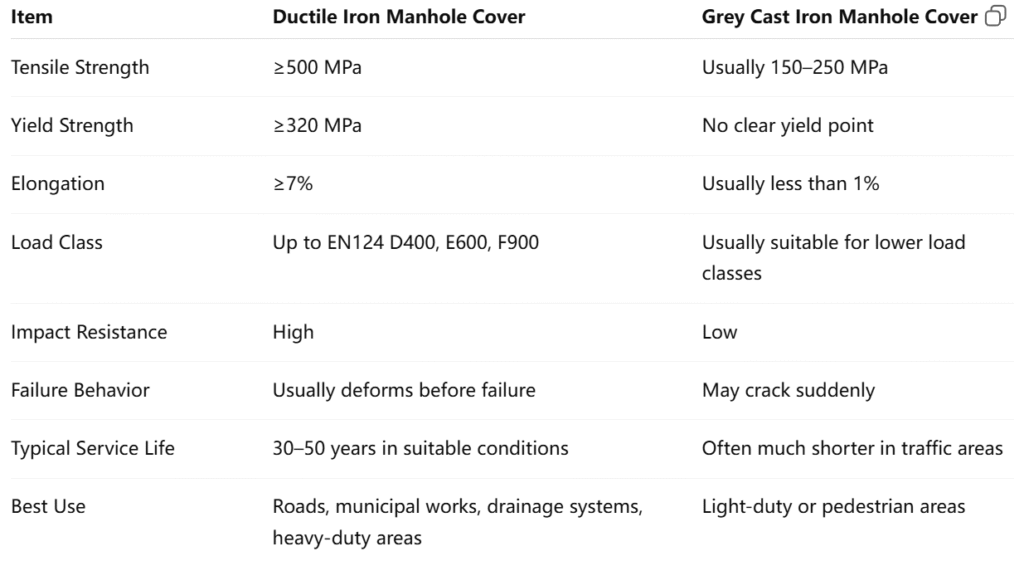
This table gives a quick overview, but the real value becomes clearer when we look at actual project conditions.
Load Capacity: Why EN124 D400 Matters
Load capacity is usually the most important factor when selecting a manhole cover.
For areas with vehicle traffic, especially roads, parking areas, logistics zones, industrial sites, and municipal drainage systems, the cover must be able to handle repeated loading over many years.
EN124 D400 ductile iron manhole covers are designed for a 400 kN test load, commonly referred to as a 40-tonne class. This makes them suitable for carriageways, urban roads, and areas used by cars, buses, and trucks.
Grey cast iron covers are generally used for lighter-duty applications. They may be acceptable for pedestrian areas, parks, green belts, or low-traffic spaces, but they are not recommended for heavy vehicle areas.
The risk is not only that a grey cast iron cover may break. The bigger concern is that it can fail suddenly, without visible warning.
For public roads and municipal infrastructure, that is a serious safety issue.
Safety: The Difference Between Cracking and Deforming
One of the main reasons engineers prefer ductile iron is safety.
Grey cast iron is brittle. When it reaches its limit, it may crack or break suddenly. A cover can look fine from the surface but still have internal damage. Once a heavy vehicle passes over it, the cover may fail without warning.
Ductile iron behaves differently. Because it has better toughness and elongation, it is more likely to bend or deform before complete failure. This gives a visible sign that the cover has been overloaded or damaged.
That difference is important in real life.
A manhole cover is not just a product sitting on the road. It is part of a public safety system. It needs to protect vehicles, pedestrians, cyclists, workers, and underground utilities.
For projects where safety matters, ductile iron is usually the better choice.
Service Life: The Cheaper Cover Is Not Always the Lower-Cost Option
Many buyers compare only the unit price. But for infrastructure products, the purchase price is only one part of the cost.
A grey cast iron manhole cover may be cheaper at the beginning. However, if it cracks, moves, or needs replacement after a few years, the real cost becomes much higher.
Replacement does not only mean buying another cover. It may also involve:
- Labor cost
- Transport cost
- Road closure or traffic control
- Maintenance time
- Project delays
- Safety risk
- Possible complaints or liability
A high-quality EN124 D400 ductile iron manhole cover costs more upfront, but it is designed for long-term use. In suitable conditions, its service life can reach several decades.
For contractors, distributors, and municipal project owners, that often means fewer replacements, lower maintenance pressure, and better long-term value.
Where Should Ductile Iron Manhole Covers Be Used?
Ductile iron manhole covers are recommended for most medium-duty and heavy-duty infrastructure projects, especially where vehicles may pass over the cover.
Typical applications include:
- Urban main roads
- Secondary roads
- Carriageways
- Commercial parking areas
- Logistics parks
- Industrial zones
- Ports and terminals
- Drainage and sewage systems
- Gas, power, telecom, and utility networks
- Construction and civil engineering projects
For these applications, EN124 D400 is one of the most commonly used load classes. For heavier working conditions, E600 or F900 covers may be selected.
Where Can Grey Cast Iron Covers Still Be Used?
Grey cast iron is not useless. It can still be suitable for certain low-load applications.
For example:
- Pedestrian-only areas
- Parks
- Green belts
- Private yards
- Temporary construction areas
- Low-budget projects with no vehicle traffic
However, if there is regular vehicle traffic, especially trucks or heavy equipment, grey cast iron is usually not the best option.
In those cases, the lower purchase price may not justify the safety and maintenance risks.
So, Which One Offers Better Value?
If the project is only for a pedestrian area with very light loading, grey cast iron may be enough.
But for roads, drainage systems, municipal projects, commercial sites, and any area with vehicle traffic, ductile iron is usually the better investment.
It offers:
- Higher load capacity
- Better impact resistance
- Longer service life
- Higher safety performance
- Lower replacement frequency
- Better long-term cost control
In other words, ductile iron may cost more at the time of purchase, but it usually delivers better value over the full service life of the project.
Final Thoughts
Choosing the right manhole cover is not only about finding the lowest price. It is about choosing a product that can perform safely and reliably for many years.
For modern infrastructure projects, EN124 ductile iron manhole covers have become the preferred choice because they combine strength, durability, safety, and long-term value.
As a professional manufacturer and exporter, Hongke supplies ductile iron manhole covers, gully gratings, drainage covers, tree gratings, decorative cast iron covers, ductile iron pipes, and custom casting solutions for municipal, road construction, drainage, and civil engineering projects.
We can support EN124 D400, E600, and other heavy-duty specifications, with options for custom sizes, logo marking, anti-corrosion treatment, anti-theft design, and project-based requirements.
If you are looking for a reliable ductile iron manhole cover manufacturer or supplier, contact Hongke to discuss your project and request a quotation.